J2025-00
SCROLL DOWN
J2025-00
Contextual Alternate
Journal of Communication, Technology, Design, and History
5.00
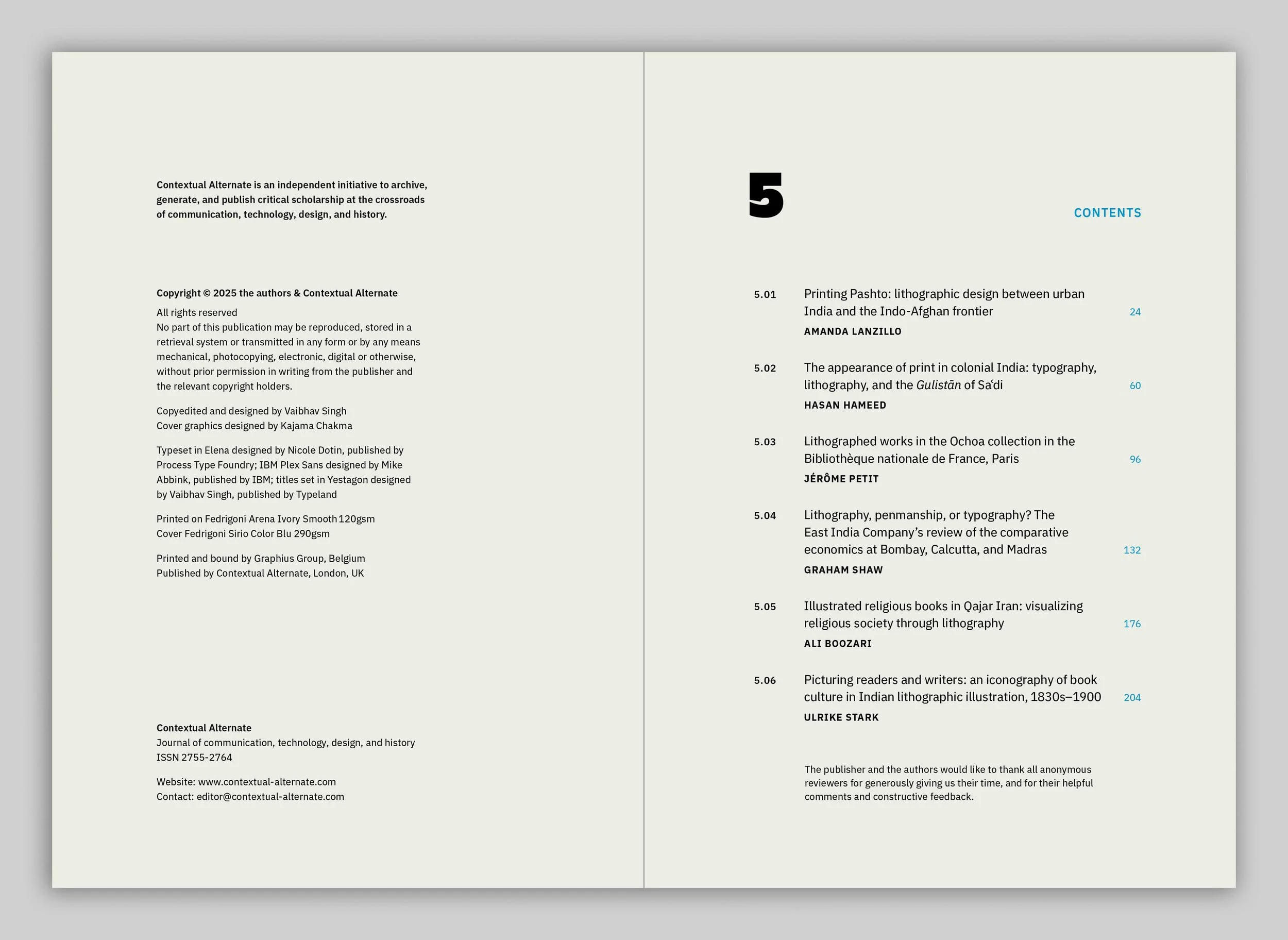
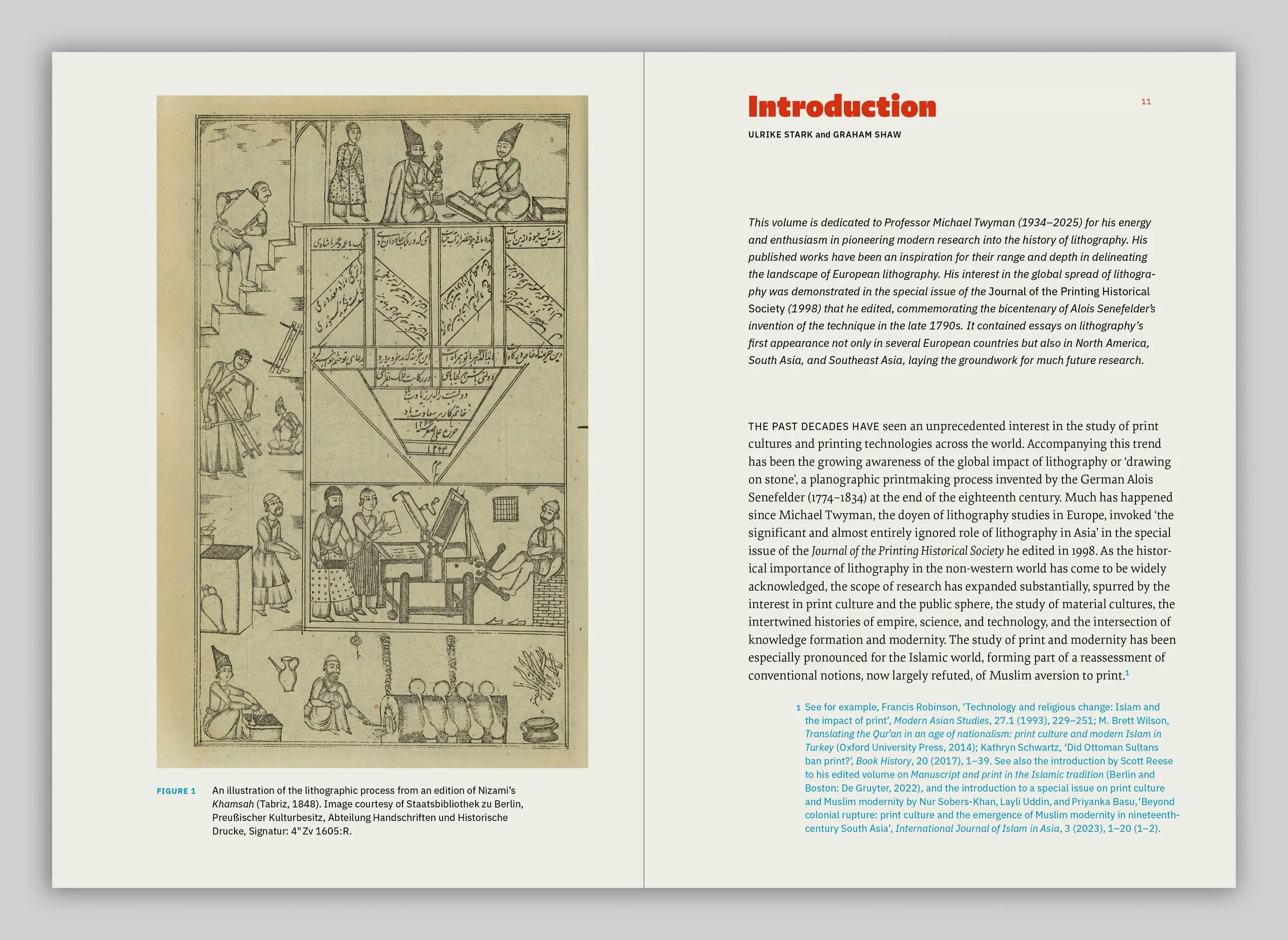
Titles and abstracts of all the essays in Contextual Alternate (volume 5) are listed below. The complete illustrated essays appear only in print. Please purchase your copy of the journal here or subscribe to lend your support to our efforts. For more information on the subscription options see here.
Volume number: 5 (2025)
ISSN 2755-2764
ISSN 2755-2764
WORLDWIDE SHIPPING
Contextual Alternate • Volume 5 (2025)
£30.00
Purchase below with debit/credit cards, or email us to order through other methods.
Paperback with flaps
256 pages · 170×240 mm
J2025-A
J2025-A
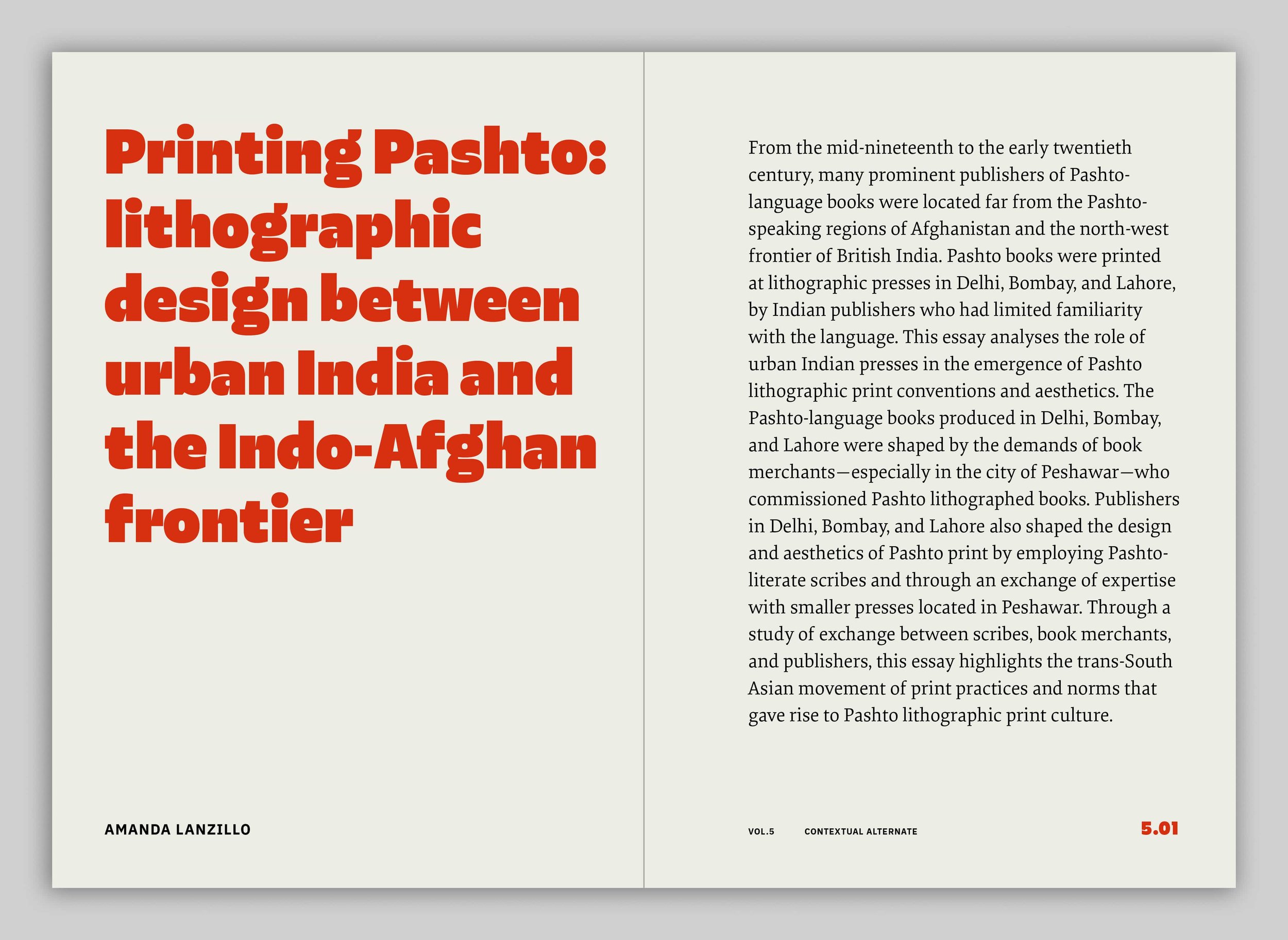
Printing Pashto: lithographic design between urban India and the Indo-Afghan frontier
5.01
From the mid-nineteenth to the early twentieth century, many prominent publishers of Pashto-language books were located far from the Pashto-speaking regions of Afghanistan and the north-west frontier of British India. Pashto books were printed at lithographic presses in Delhi, Bombay, and Lahore, by Indian publishers who had limited familiarity with the language. This essay analyses the role of urban Indian presses in the emergence of Pashto lithographic print conventions and aesthetics. The Pashto-language books produced in Delhi, Bombay, and Lahore were shaped by the demands of book merchants—especially in the city of Peshawar—who commissioned Pashto lithographed books. Publishers in Delhi, Bombay, and Lahore also shaped the design and aesthetics of Pashto print by employing Pashto-literate scribes and through an exchange of expertise with smaller presses located in Peshawar. Through a study of exchange between scribes, book merchants, and publishers, this essay highlights the trans-South Asian movement of print practices and norms that gave rise to Pashto lithographic print culture.
J2025-B
J2025-B
The appearance of print in colonial India: typography, lithography, and the Gulistan of Saʿdi
5.02
This essay examines how two distinct print technologies were used to represent divergent traditions of engaging with Persian literature in colonial India. Focusing on nineteenth-century editions of Saʿdi’s Gulistan (Rose garden), a work long central to Islamic ethical and linguistic education, it traces how colonial officials employed movable type to render Persian legible for administrative and pedagogical purposes, while Indian publishers and scholars used lithography to sustain and refashion older Persianate manu-script aesthetics. Print in colonial India, this essay argues, was not merely a material choice but an ideological one. Typographic editions embodied a colonial, utilitarian approach to language-learning, while later lithographed editions expressed a distinct Persianate tradition of reading and valuing literature. The essay demonstrates that the manuscript-like appearance of the lithographed Gulistan was not an inherent property of the medium but a historical outcome shaped by the agency of Indian publishers and scholars. It examines how print became a site for negotiating competing pedagogical, literary, and ethical claims on Persian under colonial rule.
J2025-C
J2025-C
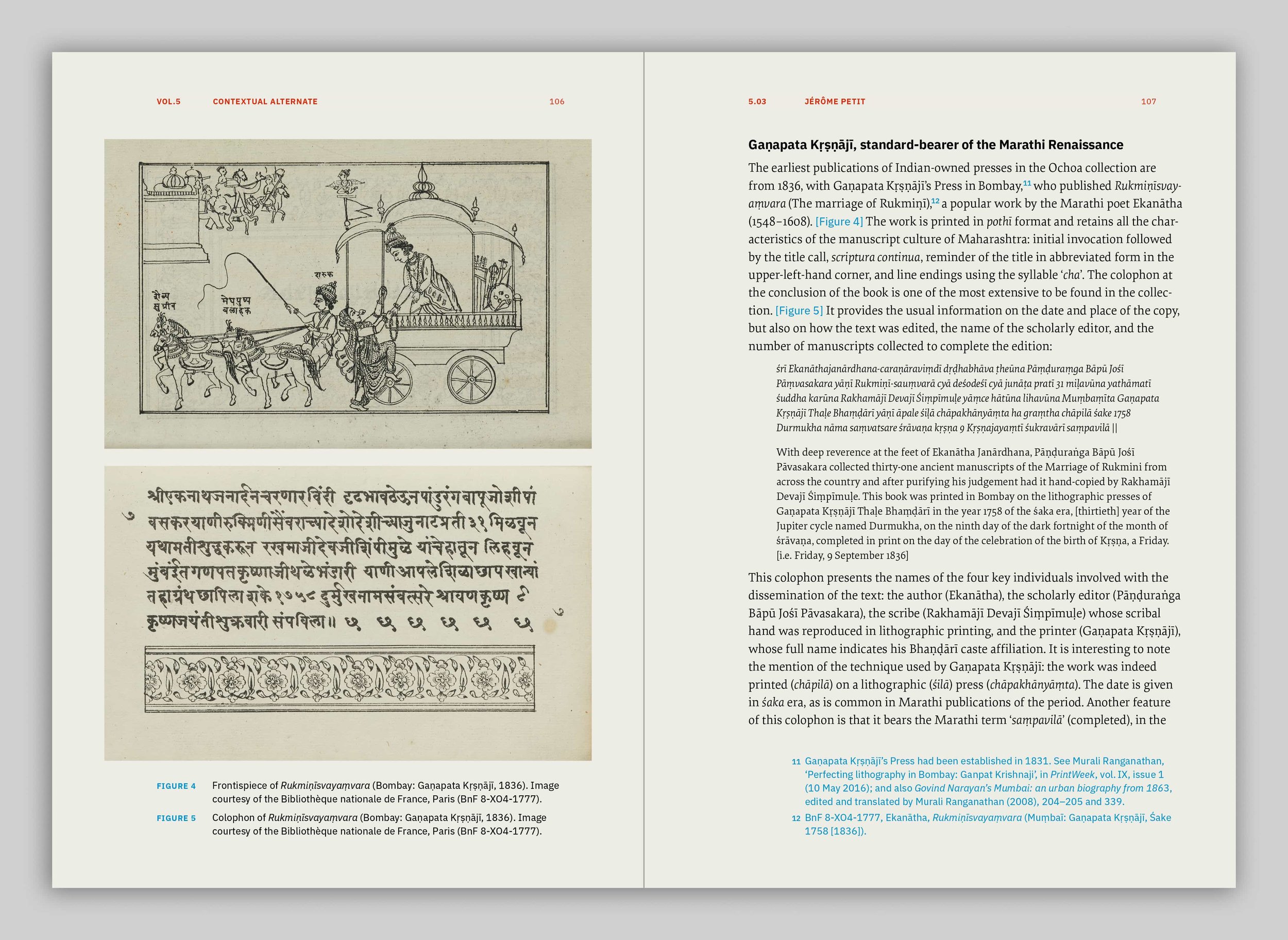
Lithographed works in the Ochoa collection in the Bibliothèque nationale de France, Paris
5.03
In 1843, at the instigation of the French Ministry of Public Education, Charles d’Ochoa, a twenty-seven-year-old merchant clerk from Bordeaux, undertook a scholarly mission to Maharashtra to gather materials needed to write a history of Indian literature. During a year and a half of his mission in western India, he collected works in the many languages in use in that region. In his collection, now held at the Bibliothèque nationale de France (BnF) in Paris, are over a hundred books lithographed in presses that had been recently set up in Mumbai and Pune. The study of the Ochoa collection, and the reading of the books’ colophons in particular, provides a snapshot of the printing and publishing scene in Maharashtra in the first half of the nineteenth century. Many of the lithographed books in the collection present layouts, formats, and other distinct characteristics borrowed from Indian manuscript traditions, in addition to a wide variety of influences from the Indo-Persian world as well as European print culture.
J2025-D
J2025-D
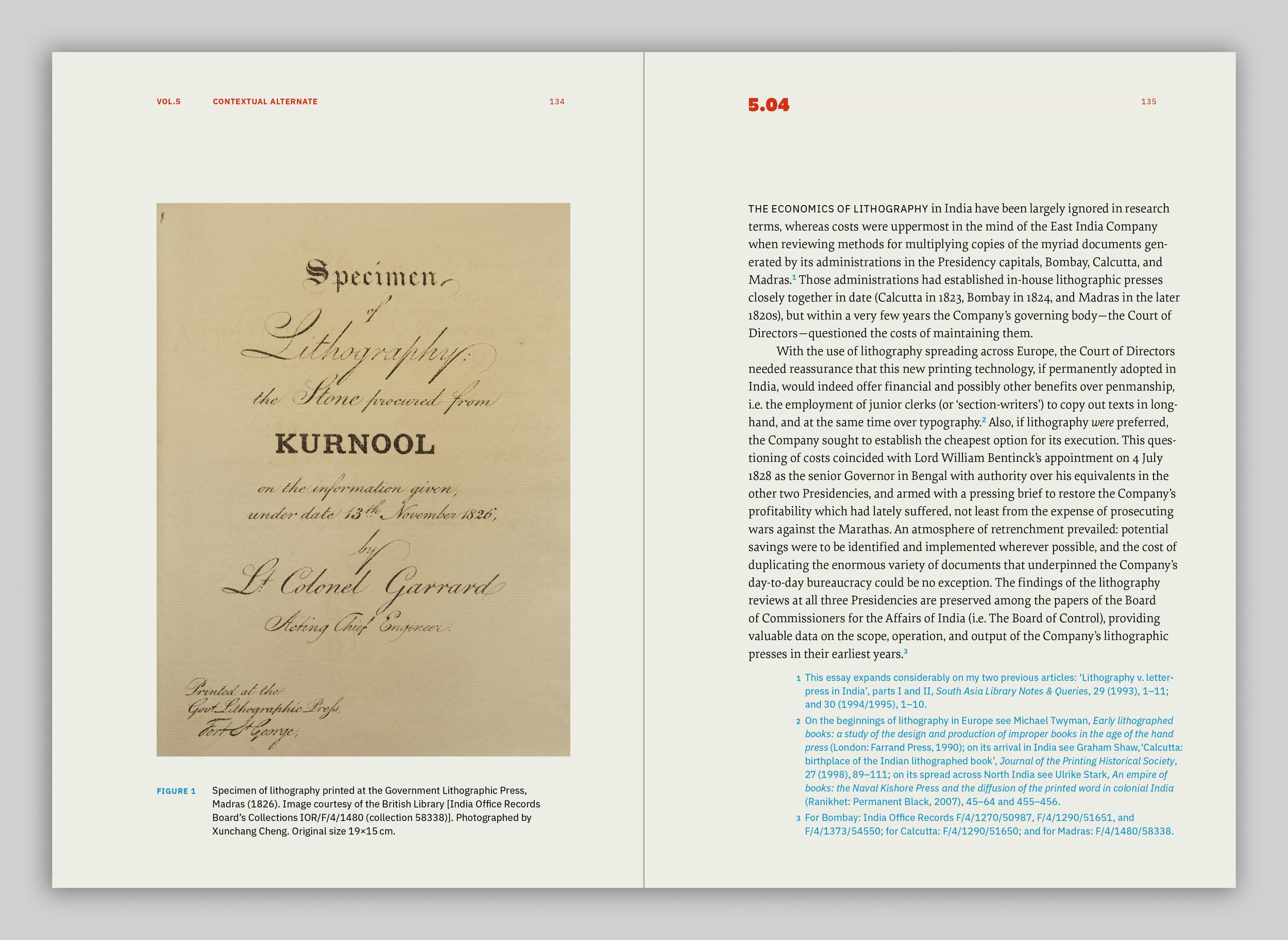
Lithography, penmanship, or typography? The East India Company’s review of the comparative economics at Bombay, Calcutta, and Madras
5.04
This essay examines the largely ignored economics of early lithography in India. In the late 1820s, cost considerations drove the East India Company to institute reviews of the various methods employed in making copies of the myriad documents required by its administrations at Bombay, Calcutta, and Madras. With lithography’s use spreading across Europe, the Company’s Court of Directors sought to ascertain whether this new printing technology, if permanently adopted in India, might offer financial and/or other benefits over both penmanship (employing clerks or ‘writers’ to copy out texts) and typography. Apart from
providing a breakdown of relative costs, the outcomes of the reviews preserved in the India Office Records reveal details of the scale and demand for lithographic printing by government, production schedules, and materials supplied from London or procurable locally. Not least, different results at each Presidency reflect how other agendas intervened in the discussions, such as the desire to promote Western-style education, the need for improved mapping, and the provision of technical training for the Company’s armies.
J2025-E
J2025-E
Illustrated religious books in Qajar Iran: visualizing religious society through lithography
5.05
This essay focuses on illustrated lithographed books in Qajar Iran depicting religious themes and eminent religious figures. Along with the classics of Persian literature, religious books played an important role in the history of Persian manuscript culture and lithographic printing. Their publication, both the cause and the effect of increasing literacy, was backed by religious sponsors and assisted in the expansion and reformation of religious society. The lithographic illustrations in these books shaped the aesthetics of the era and were carried into other forms of visual art such as painted glass and painted tiles. This essay explores three types of illustrated tales that are either based on historical occurrences or include fantastical elements such as mythical journeys and supernatural beings: ‘Stories of the Prophets’, ‘Stories of the Shia Imams’, and ‘Stories of the Prophets and the Fourteen Infallibles’. It argues that, blurring the line between fantasy and reality, illustrated religious books were key to presenting Shia Imams not only as religious leaders but also as superhuman beings with supernatural powers.
J2025-F
J2025-F
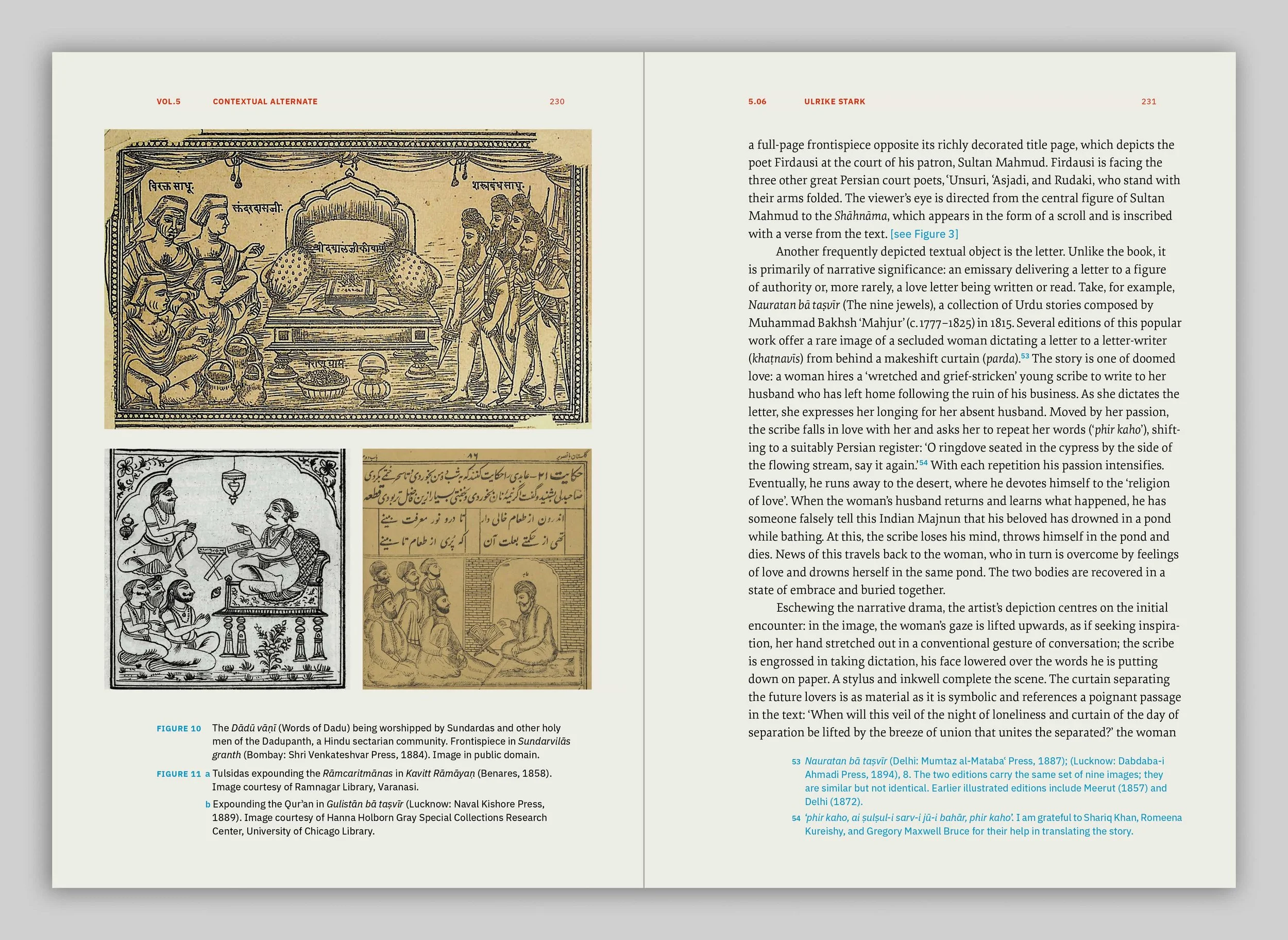
Picturing readers and writers: an iconography of book culture in Indian lithographic illustration, 1830s–1900
5.06
Despite growing interest in lithography in South Asia, the rise of lithographic illustration as a commercial book art in India remains understudied. This essay brings together questions of print technology and visual culture. It traces the emergence of lithographic illustration in Indian books beginning from the 1830s. Focusing on a subset of images depicting scenes of
reading and writing, the essay attempts an iconography of book culture at a historic moment marked by unprecedented access to printed materials, the rise of literacy and education, and the formation of reading publics. While borrowing from the Persian tradition, Indian lithographic illustration was embedded in South Asia’s multilingual print economy and formed part of an evolving visual economy that encompassed traditional book arts, Company-style painting, and photography. In discussing objects, spaces, embodied practices, and categories of readers and writers, this essay moves beyond the lithographic image’s narrative
function to explore the aesthetic, iconic, and affective dimensions of the depiction of books and the bonds created visually between material artifact, author, and reader/viewer.
J2025-authors
J2025-authors
AUTHOR BIOGRAPHIES
5.01
Amanda Lanzillo is Assistant Professor in the Department of South Asian Languages and Civilizations at the University of Chicago. She is the author of Pious labor: Islam, artisanship and technology in colonial India (University of California Press, 2024). She holds a PhD in History from Indiana University, and she studies the intersections of religious history, labour history, and the history of technology, focusing on the social worlds of South Asian Muslim communities under European colonialism. She is currently working on two new monographs about mobility between Afghanistan and the British Empire. The first, titled Out of empire: a social history of the India-Afghanistan Hijrat of 1920 (under contract with University of North Carolina Press), draws on memoirs and personal testimonies to tell the stories of tens of thousands of Indian Muslims who attempted to depart British India for Afghanistan in 1920.
5.02
Hasan Hameed is a doctoral candidate in History and Islamic Studies at Princeton University. His research explores how texts travel – linguistically, materially, and ethically – across regions and empires. His dissertation, ‘The ethics of erotics: Persian literature and Islam in colonial India’, traces how Persian classics such as Saʿdi’s Gulistan became sites where desire, ethics, and education were renegotiated within South Asia’s encounter with colonial modernity. Beyond the dissertation, he is developing a digital humanities project that maps Persian literary networks across early modern Eurasia. Hasan’s broader interests include manuscript and print histories, gender and sexuality in Islamic thought, and the everyday life of texts in multilingual societies. His writing has appeared in Modern Intellectual History and Startwords: A Journal of Experimental Humanities. He has taught and lived in Karachi, Oxford, and Princeton, experiences that continue to shape his thinking about language, ethics, and intellectual community.
5.03
Jérôme Petit is curator in charge of the South Asia manuscript collections at the Bibliothèque nationale de France (BnF) and Professor of Indian manuscript cultures at the École Pratique des Hautes Études (EPHE-PSL) in Paris. He is interested in the Jain Digambar mystical tradition and has translated several works by eminent Jain authors into French, including Samayasāra: La quintessence du soi (2021) by the second-century Jain monk Kundakunda, Ātmasiddhi: La réalisation du soi (2020) by the nineteenth-century poet and mystic Śrīmad Rājacandra, and Ardhakathānaka: Histoire à demi (2011) by the seventeenth-century merchant Banārasīdās. His most recent book, La Mission de Charles d’Ochoa (2025), traces the history of the Indian manuscript collections of the BnF, with a particular focus on the 1843 mission to Maharashtra.
5.04
Graham Shaw is a Senior Research Fellow of the Institute of English Studies, School of Advanced Study, University of London. He was formerly Head of the Asia, Pacific, and Africa Collections at the British Library. Among his many achievements are leading the ‘Collect Britain’ project, the British Library’s largest digitisation initiative at that time, and devising and directing the Endangered Archives Programme for its first five years.
In 2010 Graham Shaw retired from the British Library, having been Head of the Library’s Asia, Pacific, and Africa Collections (APAC) for over twenty years. Trained as an Indologist, he graduated in Hindi and Sanskrit in 1969 from the School of Oriental and African Studies, University of London (SOAS).
For the past thirty years he has researched the history of printing and publishing in South Asia, from the 16th to the 20th centuries. His published works include Printing in Calcutta to 1800 and The South Asia and Burma Retrospective Bibliography (SABREB): Stage-1, 1556–1800.
5.05
Ali Boozari is an illustrator, art historian, and faculty member at the Iran University of Art. His research focuses on nineteenth-century Persian art, the development of the printing industry and history of illustration in Iran, and Persian illustrated lithographed books. He is the author of several books and numerous articles on Persian art and print culture of the Qajar period. His recent monograph on Persian incunabula (2024) presents the first comprehensive study of early movable-type printing in Iran and its cultural significance. His work on the visual and literary traditions of Qajar Iran extends to illustrated and translated versions of The thousand and one nights, situating them within the broader history of Persian visual heritage and cross-cultural exchange. Boozari has held several distinguished fellowships, including research appointments at the Metropolitan Museum of Art in New York, the Library of Congress in Washington DC, the Bodleian Library at the University of Oxford, and the International Youth Library in Munich.
5.06
Ulrike Stark is Professor in the Department of South Asian Languages and Civilizations at the University of Chicago. She holds a PhD from the University of Bamberg and received her Habilitation in Modern South Asian Languages and Literatures from the University of Heidelberg in 2004. Stark taught at the South Asia Institute of Heidelberg University for more than a decade before she joined the University of Chicago in 2005. Her research focuses on modern Hindi literature, South Asian book history, and the cultural and intellectual history of North India in the nineteenth and early twentieth centuries. She is the author of An empire of books: the Naval Kishore Press and the diffusion of the printed word in colonial India (Ranikhet: Permanent Black, 2008) and has published widely on Hindi and Urdu print culture. She is the co-creator and principal investigator of a digital humanities project titled ‘Chapakhana: mapping the spread of print in South Asia’.